

On Tuesday, Oct. 20, a bus from Bridge House, a treatment program that has served New Orleans for more than 65 years, pulled through the white fence and gates of Manresa House of Retreats in Convent, Louisiana. The men on board were not sure what they had signed up for. “The last thing they want is a bunch of people preaching to them,” says Ronnie Briggs, who has led the Ignatian Spirituality Project (ISP) men’s team in New Orleans since 2014. “So they’re a little skeptical.”
By Wednesday morning, the same men did not want to get back on the bus. “You have to go find them hiding,” Ronnie says, “or they say, ‘How can I come back here?'” One of them wrote afterward: “I’ll never forget this retreat. It was a blessing from God.”
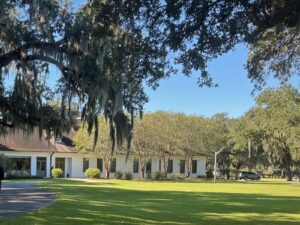
Manresa has hosted every one of the New Orleans men’s team’s 40 ISP retreats.
It was the team’s 40th ISP retreat at Manresa, and Manresa has hosted every one without charging ISP. “Without Manresa,” Ronnie says, “we wouldn’t be where we are today.” Ronnie tells the men what the Jesuits told him: “You’re here by the grace of God, but paid for by others.”
“I deserve to give myself credit and feel love.”
ISP New Orleans participant
What the retreats have changed
A partner’s view
Kevin Gardere, CEO of Bridge House / Grace House: “The facility is phenomenal. It’s gorgeous … And to think that our men and women get to go to this facility, it still blows me away.”
He also sees what it does for the men once they’re home: “The longer you’re here, the better chance you have to maintain continuous sobriety … I truly believe that the individuals who go on ISP retreats stay longer than the rest of the population.”
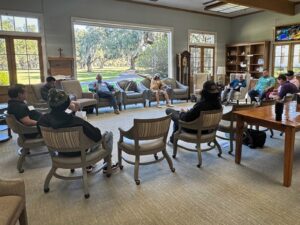
The retreat in session at Manresa.
Each retreat lasts a day and a night. Forty times now, the change in the men, from skeptical to not wanting to leave, has started with the place itself. Br. Larry Huck, S.J., Manresa’s director, says its setting lets people “let go of the world they came from.” In the quiet under the oaks, God says, in Br. Huck’s words, “Just sit and be still, and let me care for you.”
From there, the change has come in different ways for different men. Some of it has come through the talks, the good meals, and the quiet hours on the grounds. Some has come in the small groups, where men have opened up to each other. “I got to share my story and learn about the stories of my two other friends as well,” one wrote on his evaluation in October. And some has come through an exercise called Healing of Memories: each man drops a stone into a bowl of water while someone prays over him, a way of leaving something behind and making space for something new. “I feel like it lifted my burden,” another wrote.
For some men, the turning point has been time with a priest, and sometimes a first confession in many years. Over the years, Ronnie has waited for them to come out. “Not every time,” he says, “but a lot of times, you can see the change. You can see the emotion. You can see the relief.” He remembers a young man who had spent years in prison and was back in treatment after a relapse. It was his first confession in 20 years. Afterward, the young man told Ronnie what happened when it came to his penance. The priest asked how many years he had spent in prison, then said, “You’ve already done your penance.” Ronnie says, “I don’t think I’ll forget that.”
Manresa has welcomed women the same way. Since 2013, it has hosted ISP’s retreats for the women of Grace House, Bridge House’s sister program. Some have arrived “skeptical about God,” says Susan Rodriguez, who helped start the women’s team. One had a hard time picturing God at all. Then she thought of her puppy, who met her at the door thrilled to see her, even when she had been gone all day or had forgotten his food. “No matter where we’ve been, no matter how long we’ve been away,” Susan says, “God is always thrilled to see us.” By the end of a retreat, “they don’t want to leave.” They ask for a two-night retreat.
None of this replaces treatment or recovery meetings. “We’re one of the pieces in the overall puzzle,” Ronnie says, “and without any one of those pieces, it’s a struggle to see the whole picture.” What every retreat has added is the welcome, the care, and, in Susan’s words, being “loved exactly as they are.”
Thank you, Manresa

Quiet hours on the grounds are part of every retreat.
The men have said what the retreats give them better than anyone. “It gave me hope,” one wrote at the end of the October retreat. “That faith and fellowship is very powerful,” wrote another. Some have come back on their own. Earlier this year, Br. Huck wrote to Ronnie that a man from an earlier retreat had returned to Manresa for three days of silence.
“No matter where we’ve been, no matter how long we’ve been away, God is always thrilled to see us.”
Susan Rodriguez, ISP New Orleans women’s team
All of this has depended on a house that says yes. Asked why Manresa keeps opening its gates, Br. Huck says that what has been built there over 95 years “should be shared with the men and women who make the ISP retreats.” Years ago, Susan got the same answer from Fr. Len Kraus, a Jesuit at Manresa then, whenever she tried to thank him: “No, thank you for bringing the ladies here. This is exactly what Jesuits are supposed to be involved in.”
So to Br. Huck, the Jesuits, and everyone at Manresa: thank you for 40 retreats with our men’s team, for the women’s retreats since 2013, and for every one still to come. “Great relationships turn out great results,” Ronnie says. “And ISP and Manresa have a great relationship.”
The people who have led the retreats have been changed too. The men’s team is eight men today, and all but Ronnie are in recovery themselves. They know what the men stepping off the bus are carrying, because they have carried it. Susan calls the retreats “life-giving for me and for all the team members.” Ronnie has left every one “filled with gratitude.” “God has been good to me,” he says. “I’ve got to put it back.”

The 40th retreat of our New Orleans men’s team at Manresa, October 2026.
0 Comments