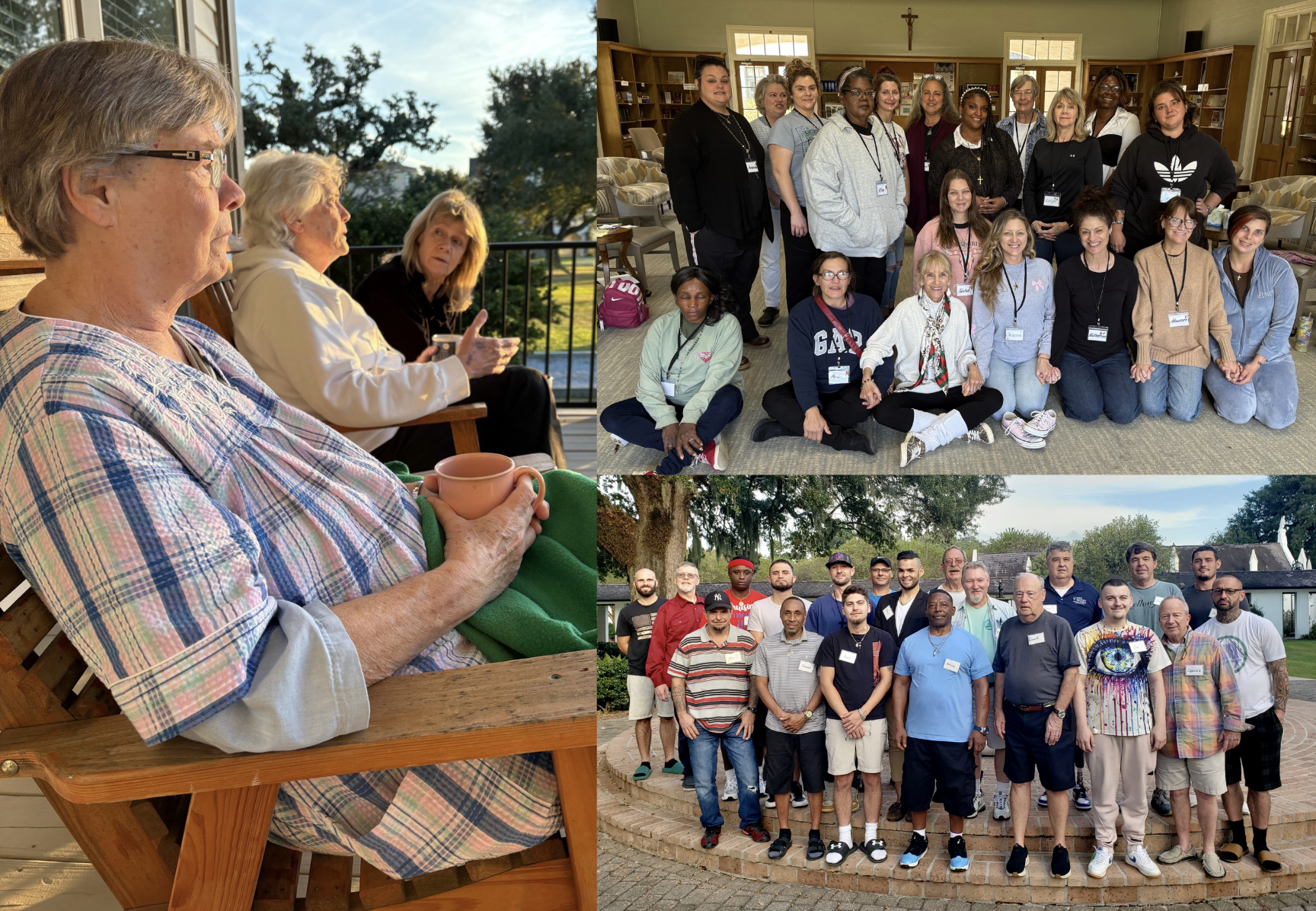
In the world of addiction recovery, we measure success in days of sobriety, employment rates, and housing stability. These metrics are vital. But anyone who has walked the road of recovery knows that before you can rebuild a life, you have to rebuild the belief that you are a person worth saving.

Kevin Gardere, Executive Director of Bridge House / Grace House
For over a decade, Kevin Gardere, Executive Director of Bridge House / Grace House in New Orleans, has partnered with the Ignatian Spirituality Project (ISP) to provide that missing piece.
In a recent conversation, Kevin shared why, in a facility focused on clinical outcomes, he views the spiritual work of ISP as an essential investment in long-term success.
“No Skin in the Game”: The Architecture of Dignity
Kevin notes that when the men from Bridge House return from an ISP retreat at the Manresa House of Retreats, the change isn’t just internal—it’s visible. He describes it as seeing “a glow” about them.
This transformation begins with the environment itself. ISP retreats don’t happen in clinical basements; they happen in places of beauty. As Kevin describes it:
“The facility is phenomenal. It’s gorgeous… The buildings, the food. Everything about it is top notch… And to think that our men and women get to go to this facility, it still blows me away.”
But the environment is just the container. The true transformation comes from the people. For men and women accustomed to the transactional nature of social services, the ISP model offers something radically different. Our volunteers aren’t paid caseworkers managing a file. They are trained facilitators who choose to show up, to listen, and to walk alongside participants as equals.
Kevin points to this voluntary presence as the catalyst for self-worth:
“Your self-worth increases so much because you realize… these people have no real skin in the game. They have nothing to win by helping you. Yet they are still doing it and volunteering that time.”
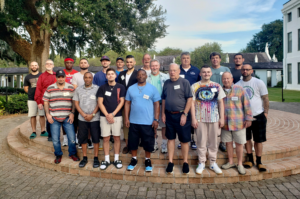
The ISP men’s team in New Orleans in 2025
When a participant realizes they are worth someone’s time—with no strings attached—the foundation for recovery hardens. They aren’t a problem to be solved; they are a person to be loved.
External Validation: “Blown Away” by the Impact
We know that our donors and partners value excellence and accountability. Kevin shared that during a recent audit by CARF (Commission on Accreditation of Rehabilitation Facilities)—the gold standard for addiction treatment accreditation—the surveyors looked beyond the standard clinical protocols.
“The clinical surveyor was blown away by some of the things they saw… and the fact that the participants get to go on this retreat.”
They recognized a fundamental truth: that holistic care must tend to the spirit as well as the body.
Linking Hope to Sobriety
At ISP, we often describe our work as a spiritual foundation. You cannot drop someone into housing or employment and expect a transformation if their spirit is still crumbling.
Kevin confirms this link between the “soft” skill of serenity and the “hard” metric of retention. He observes that the “internal peace” participants find on retreat becomes a tool they use to survive the difficult days of early recovery.
“It lasts a little bit longer. That glow about them… The internal peace that they have… just the serenity is more than anything. And hope, you know, falls in right after that.”
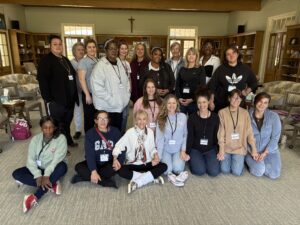
The ISP women’s team in New Orleans
Kevin notes that while Bridge House focuses on the clinical side, ISP provides the grounding that helps those supports stick.
“The longer you’re here, the better chance you have to maintain continuous sobriety… I truly believe that the individuals who go on ISP retreats stay longer than the rest of the population.”
The inner peace found on a retreat translates directly into the resilience needed to stay in treatment.
Your Support for Their Journey
These retreats—hosted at premier centers like Manresa—are high-quality experiences. They are not “free”; they are fully funded by the generosity of our partners.
When you support ISP, you aren’t just paying for a weekend away. You are funding the scaffolding that allows clinical treatment to take root. You are providing the resources that allow our teams to walk with participants until they can walk on their own.
As Kevin notes, the retreat experience helps participants believe: “Maybe I can do it. Maybe I can finish this program.”
Your support makes that belief possible.
0 Comments