Ignatian spirituality is supposed to be lived. Contemplatives in action. Men and women for others. Finding God in all things. These aren’t aspirations meant to stay on a banner in the hallway. ISP is what it looks like when they come alive, on the margins, in recovery, among people who’ve found God through spirituality after losing nearly everything else.
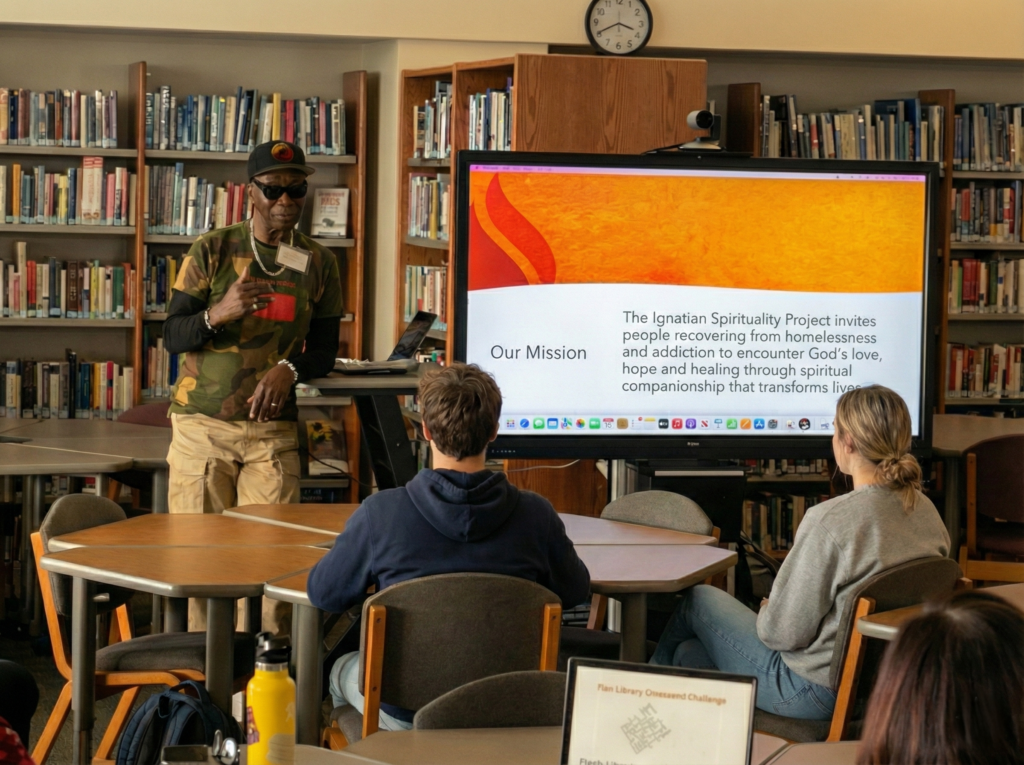
And when those people walk into a Jesuit high school, something clicks that’s hard to replicate in a classroom.
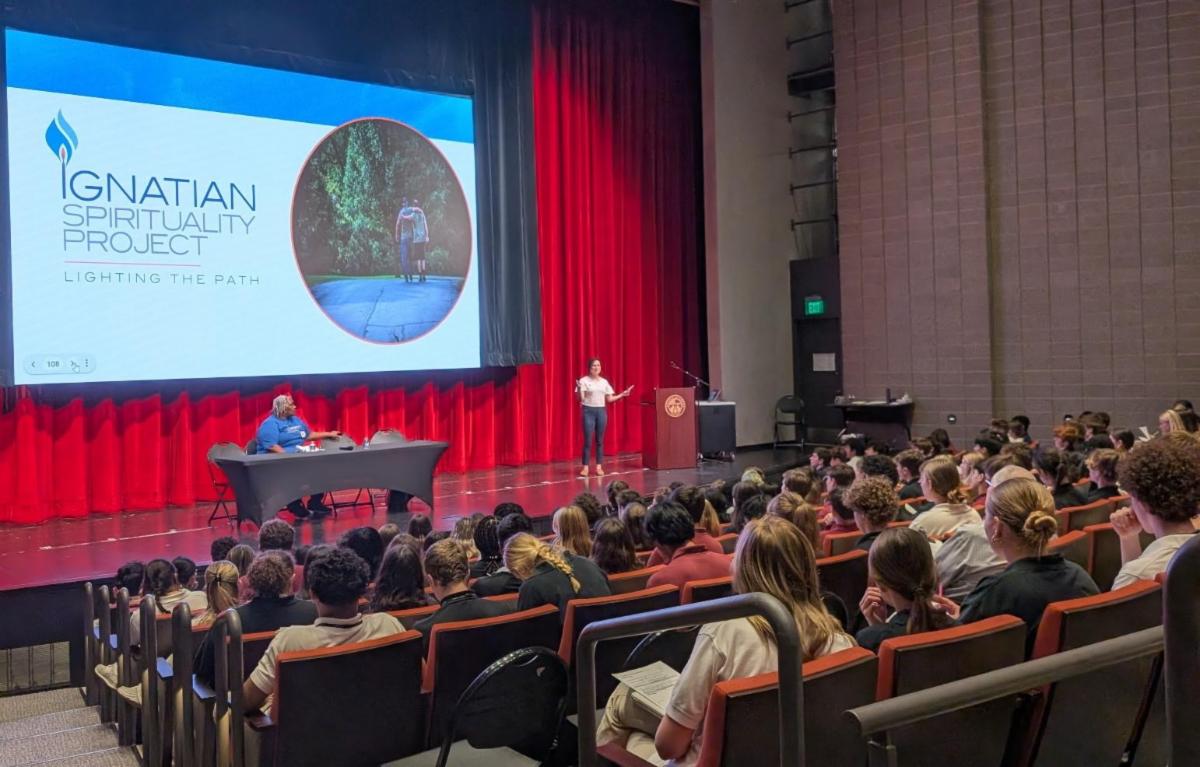
At Regis Jesuit High School in Denver, it happened during a Diversity Day breakout session in 2023. ISP’s Jim Broderick-King and Jerome, an ISP alumnus, led a Diversity Day breakout session together in 2023. Jerome had lived through incarceration, addiction, and homelessness before finding recovery through spiritual companionship. He told his story to 25 students. Then he opened the floor. This was one of several small-group sessions Jim and Jerome led that day.
The questions came fast. What do I actually do when I pass someone on the street who’s unhoused? My uncle is struggling with addiction. How can I help him? And then, unprompted: This sounds like my Kairos retreat.
Students began connecting their own formation to the lived experience of someone in recovery.
That’s when the shift happens, Jim says. Students stop seeing people in recovery as objects of charity. They start seeing them as people who have something to teach out of their own lived experience.
“Learning about ISP’s involvement in the lives of people in recovery provided me with a renewed perspective on the spiritual opportunities in my own life. Being able to listen to a story so different and so much more challenging than mine allowed me to empathize and motivate myself to connect to those experiencing similar things.”
— Senior, Regis Jesuit High School
What is ISP?
The Ignatian Spirituality Project (ISP) provides retreats and reflection circles to people recovering from homelessness and addiction in more than 20 cities nationwide. Rooted in Ignatian spirituality but open to people of all faith backgrounds, ISP creates space where spirituality and community become part of the recovery journey. Last year, nearly 7,000 people in early recovery joined an ISP program. Over 95% report an improved sense of self-worth, belonging, and hope after their first ISP experience.
ISP alumni, people with lived experience who have joined ISP retreat teams, are increasingly bringing their stories into Jesuit high schools.

What this looks like in practice
Regis Jesuit has invited ISP to present in a variety of formats: Diversity Day breakouts, senior theology classes on social justice, faculty formation sessions, and student panels. Each one started with a conversation. Across these formats, students keep circling back to the same realization: the people they meet aren’t objects of charity, but wisdom figures.
At Loyola Academy just north of Chicago, Ambassador of Hope Queen Brown shared her journey from addiction and homelessness to recovery and purpose during the school’s “Putting Love Into Action” symposium. When she finished, the room was different. Hands went up across the auditorium. Afterward, a staff member shared with ISP Regional Director Claire DesHotels: “You reinforced everything we’re trying to teach, but it hits differently when Queen is talking about it versus when we say it in class.”
And there are other creative ways to engage beyond simply presentations. Staff at St. Ignatius College Prep in Chicago invited students who had recently made their Kairos retreat to write letters to ISP retreatants, connecting their Kairos experience with the ISP retreat. Fifty students from Christ the King Jesuit College Prep joined Chicago’s Winter Walk this year. ISP has presented at Ignatian Solidarity Network’s Teach-In in Washington, DC. Each engagement looks different. The pattern holds: when students encounter someone whose life has been shaped by recovery and spiritual companionship, the Ignatian values they’ve been studying come alive.
How this connects to the Universal Apostolic Preferences
ISP’s work naturally embodies two UAPs: showing the way to God and walking with the excluded. A school partnership adds a third: walking with youth. ISP didn’t set out to be a formation partner for high schools. But when alumni in recovery tell their stories to students formed in Ignatian spirituality, the encounter goes both directions. Students see their values reflected in someone whose life looks nothing like theirs. Alumni experience the dignity of attentive listening and making a difference as people of faith.
That mutuality is the point. It’s what Ignatian education is supposed to produce.
Interested? Let’s talk.
ISP partners with Jesuit high schools. We offer sessions for Ignatian Heritage, Diversity Day and Mission Day programs, theology and social justice class visits, faculty formation, and community events, led by ISP team members and alumni who choose to share their experience as part of their own continued journey of recovery and leadership.
Join us on March 18 for an online gathering to hear more and explore what a partnership could look like at your school.
Or reach out directly to Jim Broderick King at jbroderickking@ispretreats.org. We’d love to start a conversation.
The Ignatian Spirituality Project offers retreats and reflection circles for people recovering from homelessness and addiction in 20+ U.S. cities. Learn more at ispretreats.org.
0 Comments